Blog

  • Just how many Gibson SJ-300s were actually made?

    Facebooktwitterredditpinterestlinkedintumblrmail

    Ever wonder how many Gibson SJ-300s were made? I dove deep into serial numbers, forum posts, and dealer lore to find out.


    Here’s a fun way to start a conversation the next time you see your guitar nerd friend: mention the Gibson SJ-300 and watch them divide into one of three camps. Those who own one (unicorns, basically). There are those who desperately want one. And then there’s the third group—people who will look at you skeptically and ask, “Wait… does that guitar even exist?”

    Yes, it exists. I’ve found 18 with identifiable serial numbers. And after scouring Reverb listings, crawling through dusty forum threads, decoding serial numbers, and chasing down dealer descriptions from Germany to California, I’m ready to take my best shot at answering the question that has stumped Gibson acoustic enthusiasts for nearly two decades:

    Just how many Gibson SJ-300s were made?

    First, Let’s Talk About What Makes This Guitar So Special

    The SJ-300 is Gibson’s rosewood-backed answer to the legendary SJ-200, the “King of the Flat-Tops.” While the SJ-200 has been in continuous production since 1937 and has graced the hands of everyone from Elvis to Emmylou Harris, the SJ-300 was something different—a boutique whisper in a world of rock-and-roll shouts.

    Produced primarily between 2004 and 2008 at Gibson’s Bozeman, Montana facility, the SJ-300 swapped the SJ-200’s traditional maple back and sides for premium Indian rosewood. The result? A deeper, warmer, more intimate voice—what one forum member memorably described as “intergalactically delicious.”

    The spec sheet reads like a wish list for acoustic guitar nerds:

    • Top: AAA-grade Sitka Spruce
    • Back & Sides: Premium Indian Rosewood
    • Fingerboard: Bound Ebony with Abalone Crown Inlays
    • Bridge: Ebony “Moustache” with Abalone Inlays
    • Tuners: Gold Grover Imperials
    • Nut Width: 1.75″
    • Scale Length: 25.5″

    This was Gibson’s flagship Super Jumbo for the modern era—a guitar that commanded serious premium pricing and required the kind of materials and craftsmanship that naturally limited production. And then, around 2008, it quietly disappeared from the catalog, folded back into the SJ-200 line as the “SJ-200 Custom.”

    Gone, but not forgotten.

    The Ren Ferguson Era: Built Under a Master’s Watch

    Here’s something that makes every SJ-300 even more significant: every single one was built during the legendary Ren Ferguson era at Gibson Montana.

    Ferguson joined Gibson in 1986 when the company acquired Flatiron Mandolin, where he served as head luthier. For the next 25 years, he spearheaded the design and construction of Gibson Acoustic in Bozeman, earning recognition as one of the finest Master Luthiers in the world. When Gibson announced his retirement in 2012, then-CEO Henry Juszkiewicz stated that Ferguson had been “an integral part of arguably one of the best periods of acoustic guitar building for Gibson.”

    That’s not corporate hyperbole. Gibson dealer Mike Fuller of Fuller’s Vintage Guitar in Houston put it more directly: “He is simply one of the greatest luthiers of all time.”

    Ferguson was responsible for some of the most elaborate and celebrated flattops ever to emerge from the Bozeman plant. Some of his museum-quality masterpieces have commanded upwards of $50,000 at auction. His philosophy was simple but uncompromising: “My first priority has always been to make a guitar sound as good as the wood will allow.”

    The SJ-300’s entire production window—2004 to 2008—fell squarely within Ferguson’s tenure. Every one of these guitars benefited from his oversight, his standards, and the culture of craftsmanship he cultivated at the Montana facility.

    Why Special Editions Get That Extra Touch

    Now, I should note that Gibson’s standard SJ-200s from this era are also beautifully crafted instruments—the Bozeman facility has always maintained high standards. But here’s something I know from my own experience building, or having someone build, custom products: special editions and limited-run models like the SJ-300 invariably receive greater attention and care.

    When you’re building something exclusive—something with premium materials, intricate appointments, and a higher price tag, there’s an unspoken understanding on the production floor. The craftspeople know these instruments (in my case, microphones) will be scrutinized more closely. They know the buyers are discerning collectors who will notice every detail. The result is that extra measure of precision, that additional moment spent on fit and finish, that heightened awareness that transforms a great instrument into something truly extraordinary.

    With the Gibson SJ-300, you’re getting not just rare tonewoods and abalone inlays, you’re getting the accumulated expertise of the Ren Ferguson era applied with the focused intention that only comes with building something extra special.

    The Great Production Number Mystery

    Here’s where things get interesting—and a little maddening.

    Gibson doesn’t publish production numbers for most models. If you email them asking how many SJ-300s were made, you’ll likely get the same response others have received after contacting both Gibson USA and Gibson Europe: crickets. Likely because they don’t know…

    So we’re left with speculation, rumor, dealer lore, and my albeit small and personal Gibson SJ-300 serial number sheet.

    The numbers floating around the guitar community are all over the map:

    • ~200 units total: This figure pops up in a Gibson J-200 Facebook fan group, where one poster expressed surprise at finding an SJ-300 at a German dealer, saying “even with only 200 made” it was remarkable.
    • 92 units: A more specific (and more conservative) estimate from a dealer listing that claimed “this model was produced in a very limited run (92 units).”
    • 250-450 units: A synthesis estimate based on the documented five-year production window and comparison with similar Gibson limited runs.

    But here’s where I need to address the elephant in the room—or rather, the number that seems to have taken on a life of its own.

    The “Only 40 Made” Myth: Where Did It Come From?

    If you’ve spent any time looking at SJ-300 listings, you’ve probably seen sellers claim this guitar was part of a “limited run of only 40.”

    That 40-unit figure almost certainly doesn’t mean what people think it means.

    The most likely origin? A Sweetwater product page for the SJ-300 that included promotional language about getting “one of the first 40 SJ-300s.” This was marketing speak. An enticement for early buyers, not a production-cap announcement.

    Over time, through the magic of internet telephone, “one of the first 40” morphed into “only 40 were ever made.” It’s a classic case of misremembering meets wishful thinking. After all, “I own 1 of 40” sounds a lot more impressive than “I own one of 200.” Even so, ~200 of a single guitar model, especially a Gibson, is a finite number, making it a rare item to acquire and own.

    This doesn’t mean there wasn’t a specific 2006 Custom Shop batch of 40 units with special specs (like Madagascar rosewood instead of Indian rosewood, and red spruce tops). But that batch was just one piece of the larger Gibson SJ-300 production story, not the whole picture.

    Serial Number Archaeology: What 18 Guitars Tell Us

    Here’s where my obsessive research pays off. After hours of scouring auction sites, dealer listings, forum posts, Instagram accounts, and collector photos, I’ve documented 18 Gibson SJ-300s with identifiable serial numbers.

    If you own an SJ-300, I’d love to add yours to the database. Please reach out.

    Gibson’s Bozeman-era serial numbers follow the format YDDDYRRR, where:

    • Y: First digit of the year
    • DDD: Day of the year (001-365)
    • Y: Second digit of the year
    • RRR: Ranking/sequence number for that day

    Decoding these serial numbers reveals a fascinating production timeline:

    OrderProduction DateSerial NumberProvenance
    1Feb 8, 2006 (paper work says 2/24/2006)00396016“Some Neck Guitars” (Earliest found)
    2Feb 11, 200600426044“Ekkulkorn Pakakornsakul” (Thailand)
    3Feb 15, 200600466020“Alumpster’s Guitars”
    4Feb 19, 200600506005“Guitar Motel”
    5Feb 19, 200600506049“Russell’s Custom”
    6Feb 19, 200600506053“Lovies”
    7Feb 19, 200600506055“Cave of Tone”
    8Feb 22, 200600536026“Al Cali Collection”
    9Mar 1, 200600606032“Poven Tutti” (Instagram)
    10Mar 1, 200600606034“Steve Capp” (COA confirms date)
    11Mar 21, 200600806024“Randy Bachman Collection”
    12May 17, 200601376009“Captain Guitar Lounge”
    13Oct 7, 200602806013“Elderly” (Late 2006 build)
    14Jan 22, 200700227023“Acoustic Room”
    15Jan 22, 200700227032“Mike’s Guitars”
    16Jul 20, 200702017028“Fellowship of Acoustics”
    17May 29, 200801508010“Built for Steve Peecher” (Likely custom order)
    182006 (exact date TBD)00396016(?)“Peter McAvoy” (Serial partially obscured)

    What This Data Reveals

    The February 2006 Rush: Look at that cluster in early 2006. Gibson clearly had a concentrated production push, with at least four guitars built on February 19th alone (serials ending in 005, 049, 053, and 055). This aligns with Sweetwater’s “first 40” promotional push. You can see that we have eight in February 2006 and three in March 2006 so far. It’s with educated speculation that these February and March units are all part of the first “40” mentioned in Sweetwater’s April 10, 2006, inSync news post about the SJ-300.

    Busting the “5th Guitar Made” Myth: One listing for serial 00506005 claimed “Only 40 Gibson Custom Shop SJ-300 were produced in the Montana factory in 2006-2007, according to the serial number, this is number 5.” My data suggests this is conjecture. Serial 00396016 was built 11 days earlier, and 00426044 was built 8 days before. The “005” suffix only means it was the 5th guitar of any model stamped that day in Bozeman, not the 5th SJ-300 ever. It could be a coincidence, but it’s more likely that more than five other SJ-300s were built prior to 00506005. And, of course, we know that more than 40 were made.

    Production Extended Beyond 2006: The presence of guitars from 2007 and 2008 confirms that production continued past the initial promotional batch, though the 2008 “Steve Peecher” guitar may represent a special custom order rather than standard production.

    Global Distribution: These guitars have surfaced everywhere—from California to Thailand, from the UK to Australia. The SJ-300 was never just an American phenomenon.

    So… How Many Were Actually Made?

    Time to put forth my best guesstimate. Based on everything I’ve gathered, serial number analysis, forum speculation, dealer descriptions, historical comparisons with similar Gibson limited runs, and the rate at which these guitars surface on the secondary market, here’s my estimate:

    Total Gibson SJ-300 Production (2004-2008): Approximately 150 units

    Let me break down the reasoning:

    1. The 18 Gibson SJ-300s with identifiable serial numbers represent roughly 12% of total production, assuming a total of ~150. Given that high-end guitars tend to be well-documented by proud owners, this percentage feels reasonable.
    2. The serial number ranking digits (the last three numbers) on my documented guitars range from 005 to 055 on any given production day, suggesting relatively small daily batches mixed with other Bozeman models.
    3. The roughly 5-10 units per year on secondary markets, combined with the percentage that remain in private collections, support a total population in the low hundreds.
    4. Historical comparisons are instructive: the pre-war SJ-200 (1938-1941) saw only about 96-100 units total. The SJ-200 True Vintage Limited Edition was capped at exactly 167 units. The SJ-300 fits comfortably in this boutique territory.
    5. The “92 units” figure that surfaces in some dealer descriptions may actually be close to accurate for the primary 2006 production run, with additional guitars produced in 2007-2008 bringing the total closer to 100-150.

    The higher estimates (200-450) floating around likely account for guitars that might have been built but never shipped, prototypes, or confusion with the similar-spec SJ-200 Custom that followed.

    Why Does This Guitar Inspire Such Obsession?

    Part of the SJ-300’s mystique is that maddening combination of quality and scarcity. When a guitar is so rare that collectors debate its very existence, you know you’re in unicorn territory.

    And then there’s the sound. This is why I’m so attracted to the SJ-300. It is described as having a specific, deep resonance and a warmth and bottom end that the brighter maple SJ-200 can’t quite match. Whether that tonal difference is worth the premium is a matter of personal taste. For those who’ve found their SJ-300, the consensus seems to be: absolutely.

    A Word of Warning: Beware the Fakes

    The SJ-300’s rarity has made it a target for counterfeiters. Here are the red flags to watch for:

    • Serial numbers starting with “017”: This prefix is notoriously associated with counterfeit Gibsons.
    • Serial numbers etched or painted over the finish: Authentic Gibson serials are stamped into the wood before finishing.
    • Missing “Made in USA” stamp or incorrect font on headstock markings.
    • No fret nibs on neck binding: Authentic Montana guitars have binding that wraps around fret ends.
    • Slotted or Phillips head screws on bridge hardware: Should be rivets or specific acoustic pins.

    If a deal seems too good to be true, it probably is. At current market prices averaging around $4,400-$4,500 or higher for guitars in excellent condition, and significantly higher for Ren Ferguson personally signed versions, an SJ-300 listed under $3,000 and in good shape should trigger immediate suspicion that it could be a fake. If it is priced low, it likely has serious condition issues.

    The Bottom Line

    The number of Gibson SJ-300s remains one of the great modern mysteries of the acoustic guitar world. Produced for roughly four to five years, built in small batches by the craftspeople at Gibson’s Bozeman facility under the watchful eye of Master Luthier Ren Ferguson, and then quietly absorbed back into the SJ-200 line, it exists in that perfect sweet spot of quality, scarcity, and mystique.

    My best estimate, based on 18 documented serial numbers, countless forum threads, dealer descriptions, and comparison with similar Gibson limited runs, puts total production somewhere between 100 and 200 guitars worldwide, likely closer to the former.

    The “only 40 made” claim? Almost certainly a telephone-game distortion of Sweetwater’s promotional language about the “first 40.”

    For the collectors and players who’ve managed to secure one, the SJ-300 represents something increasingly rare in the guitar world: a genuine artifact of a specific moment in Gibson’s Montana history—the Ren Ferguson era—when the factory decided to see what would happen if you put rosewood and abalone on a Super Jumbo frame and built it like a Custom Shop piece, with all the care and attention that implies.

    For everyone else, the hunt continues. Check those Sweetwater, eBay, and Reverb alerts. Befriend your local vintage dealer. And the next time someone at a jam session asks if the SJ-300 even exists, you can tell them: yes, it does. You know of at least 18 of them.

    Only 82-182 more to go.


    Do you own a Gibson SJ-300? I’d love to add your serial number to my database. Drop a comment below with your serial and any details you have—let’s solve this mystery together.


    Sources and Further Reading:

    • Gibson Brands Forums: Various SJ-300 discussion threads
    • Reverb.com: Gibson SJ-300 listings and price guide (2004-2008)
    • Equipboard: Gibson SJ-300 specifications and market analysis
    • Sweetwater.com: Original SJ-300 Modern Classic product page
    • Guitar Motel, Captain Guitar Lounge, and various vintage dealers
    • Facebook Gibson J-200/SJ-200 Enthusiast Groups
    • Blue Book of Guitar Values: Gibson SJ-300 Rosewood (Model SJ2E)
    • Gibson.com: “Master Luthier Ren Ferguson Retires from Gibson Guitar” (2012)
    • Premier Guitar: “Big Sky Builder” – Ren Ferguson profile
    • Ren Ferguson Co.: History and background
    Facebooktwitterlinkedinrssinstagram
  • Is This The First Female Hawaii Volcano School Artist

    Facebooktwitterredditpinterestlinkedintumblrmail

    What Little We Know About The Life and Art of Clara Gregory Lindsay

    In 1891, Clara Gregory Lindsay became one of the earliest women to show her artwork in Hawaiʻi. It’s possible she is the first female painter of Hawaii’s renowned Volcano School. Although long forgotten, Clara was a socialite. With a generous spirit, and creative force whose paintings reflected the vitality she brought to her community.

    Her work, ranging from ink portraits to a luminous 1895 volcano painting, reveals a woman who possessed a deep connection to the culture and radiant landscapes of Hawaii.

    Early Life and Arrival in Maui

    Born Clara Fowler Gregory in Illinois on March 29, 1867, Clara suffered the loss of both her parents before she was six years old. Her parents were originally from New York and Connecticut. By the late 1880s, she had moved to Hamakua-poko, Maui, to live with her aunt and uncle, Mr. and Mrs. Charles Loveland. The Lovelands were respected figures in the island’s missionary and civic community.

    Historical records show her name in various forms, including Claire, Clare, or Clara, often with the middle or family names Fowler (or Fowlar) and Gregory.

    Artistic Recognition and Style

    Lindsay’s art is technically refined and publicly admired. She worked in diverse mediums including pencil, pen and ink, watercolor, and oil painting, transforming Maui’s lush landscapes and Hawaii’s fiery spectacles into intimate visions of beauty. Visitors to her Makawao home specifically praised her ability to capture the unique color effects of the island scenery.

    Her first major public recognition occurred in 1891. The Honolulu Star-Bulletin reported that “Miss Clare F. Gregory… has just completed an India-ink portrait of his late Majesty,” which was exhibited at King Bros’ art store. The publication highly praised the life-sized bust of King Kalakaua, noting that “Miss Gregory’s pencil has been quite active, and its productions entitle her to a high place among local artists”.

    A Rare Female Voice in the Volcano School

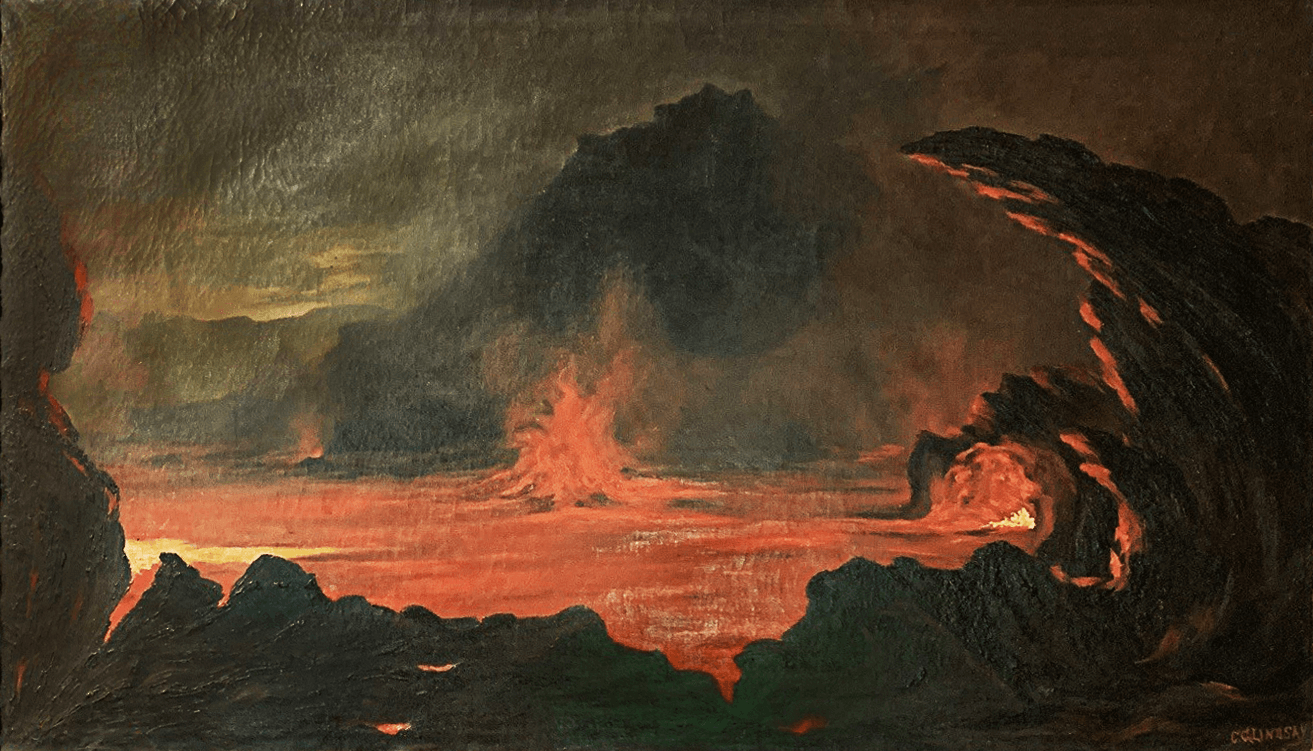
    A significant surviving work, “Volcano at Night” (1895), places Lindsay within the closing phase of Hawaiʻi’s celebrated Volcano School. The Volcano School was an informal circle of painters active between 1880 and 1900 who depicted volcanic landscapes of Hawaii.

    This 40 x 23-inch oil on canvas depicts Kīlauea’s Halemaʻumaʻu Crater, featuring a molten lava lake that illuminates the ridges and clouds with a fiery glow. The composition, with its swirling arc of dark rock and hints of blue, recalls the palettes and aesthetics of renowned artists Jules Tavernier and Charles Furneaux.

    Painted six years after Tavernier’s death, Lindsay’s work demonstrates that the tradition continued well into the 1890s and represents an extremely rare female perspective within the Volcano School movement.

    “Volcano at Night” (1895): Oil on canvas depicting Kīlauea’s Halemaʻumaʻu crater; signed “C. G. Lindsay

    Marriage and Community Service

    On July 25, 1894, Clara married David Colville Lindsay, a bookkeeper for the Paia Plantation, at the Makawao Protestant Church. Settling in Paia, Clara became a leader in community and church affairs.

    She combined her artistic life with civic service, teaching Sunday School and leading charitable projects. By 1895, she was elected president of the Makawao Ladies’ Aid Society, working alongside other prominent women in education and philanthropy. Her dual role as an artist and community builder embodied the late-Victorian ideal of uniting beauty with benevolence.

    Death and Legacy

    One of her last known artistic commissions was a pen-and-ink enlargement of a portrait of Hon. H. P. Baldwin, which was displayed at the Baldwin National Bank of Kahului and noted for its accuracy.

    Tragically, Clara Gregory Lindsay died on June 16, 1912, at the age of 45, due to complications following an appendectomy at Paia Hospital. She had recently returned from a visit to Scotland, and her sudden death was a shock to the Maui community. She was survived by her husband, four daughters, and her aunt.

    Clara Gregory Lindsay occupies a vital, yet long-overlooked, place in the story of women artists in Hawaiʻi. She expanded the Volcano School tradition beyond its masculine origins ensuring that a woman’s vision of Hawaiʻi’s natural sublime would endure on canvas.

    Known Works

    • India Ink Portrait of King Kalakaua (1891): Exhibited at King Bros.’ Art Store, Honolulu.
    • “Volcano at Night” (1895): Oil on canvas depicting Kīlauea’s Halemaʻumaʻu crater; signed “C. G. Lindsay”.
    • Portrait of Hon. H. P. Baldwin (c. 1911–12): A pen-and-ink enlargement displayed at Baldwin National Bank.
    • Watercolor Landscapes of Maui: Various dates; mentioned in her obituary as widely admired.

    Author’s Note: Reconstructing a Lost Legacy

    This post has been pieced together from limited research, including 19th and early 20th-century newspaper archives, probate records, census data, and surviving artworks. These fragments reveal a woman whose artistic and civic contributions were deeply intertwined and who serves as a vital link between the missionary generation and the emergence of modern Hawaiian art.

    Facebooktwitterlinkedinrssinstagram
  • Edouard Garcia Benito’s Gift to Condé Nast

    Facebooktwitterredditpinterestlinkedintumblrmail

    The Painting I Sold Too Soon

    Edouard Garcia Benito - Condé Nast
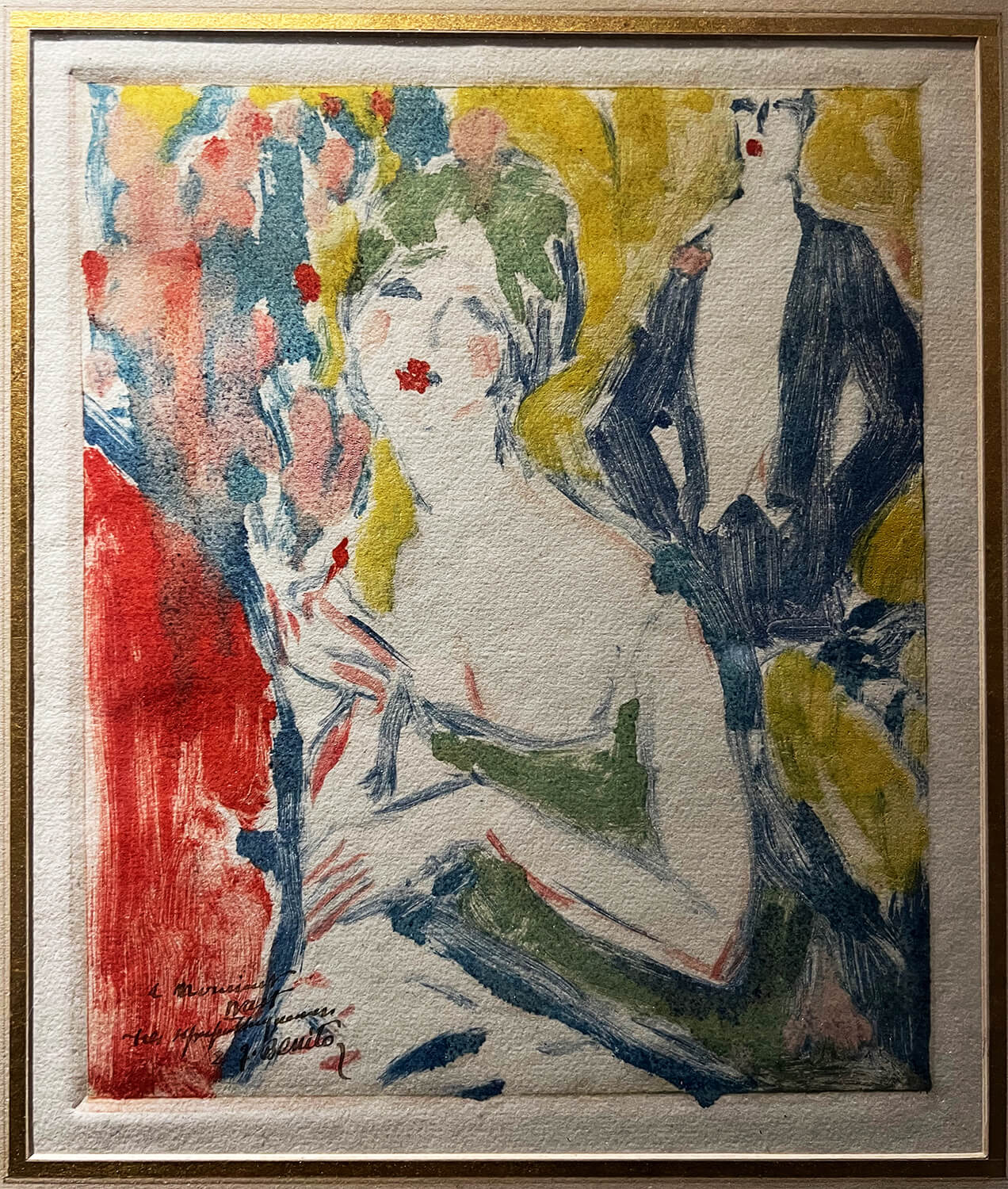
    Edouard Garcia Benito’s painting for Condé Nast

    I acquired this painting as part of a lot of five works. I admired its vibrant elegance when I saw it, but it didn’t fit my collection. I let it go, and later discovered how significant it truly was.

    It wasn’t just an attractive piece of art; it was a personal gift from the Spanish Art Deco master Edouard Garcia Benito to none other than Condé Nast, the visionary publisher behind Vogue and Vanity Fair.

    The dedication reads:

    “Le monsieur Nast très sophistiqué et penseur” — To Mr. Nast, a very sophisticated and thoughtful man.

    I misread the inscription, thinking it said something closer to Le monsieur naît (born). My impatience with getting an accurate translation meant I missed the key clue. Only when I stumbled on an image of this piece in my photos did I revisit and solve the puzzle — a bittersweet reminder that sometimes it pays to slow down in art research.

    Provenance suggests it passed directly from Benito to Nast, and later through the venerable New York gallery M. Knoedler & Co., long before Knoedler’s controversies. The elegant woman depicted may be Natica Nast, Condé’s daughter, who was often portrayed in fashionable hats.

    The composition is pure Art Deco glamour: a graceful woman in a gown, clasping her clutch under her arm, her face softly abstracted, framed by lush blossoms of red, pink, and yellow. Her red lips draw the eye, balanced by the upright figure of a man in formal evening attire behind her, hands on his hips, exuding confidence. The brushwork is loose yet deliberate, with bold swaths of color — crimson, canary yellow, moss green, deep navy — set against areas of untouched white. It’s signed E. G. Benito in the lower left, along with the inscription to Nast. The mood is equal parts sophistication and flirtation, the hallmark of Benito’s fashion illustration sensibility.

    I rarely look back on pieces I’ve let go. But letting this painting go might nag at me. It wasn’t just a beautiful work but a tangible link between two giants of 20th-century culture.

    If there’s a lesson here, it’s take your time, dig deeper, and never underestimate what a closer look might reveal. And sometimes you might want to add a zero to the price…


    About Edouard Garcia Benito

    Edouard Garcia Benito (1891–1981) was born in Valladolid, Spain, and trained at the School of Fine Arts in Valladolid and San Fernando in Madrid before moving to Paris in 1912. Immersed in the city’s avant-garde, he befriended artists like Modigliani and Dufy and began creating fashion illustrations for elite publications such as La Gazette du Bon Ton.

    His big break came in the early 1920s when couturier Paul Poiret introduced him to Condé Nast. Benito went on to produce nearly 100 covers for Vogue and Vanity Fair, defining the magazines’ Art Deco aesthetic with his bold geometric forms, elongated figures, and sophisticated minimalism. He alternated between painting society portraits and creating witty, stylish illustrations, leaving a lasting imprint on both fashion and fine art.


    About Condé Nast

    Condé Montrose Nast (1873–1942) transformed magazine publishing in the early 20th century. Acquiring Vogue in 1909 and launching Vanity Fair soon after, he targeted the cultural elite with a mix of high fashion, society reportage, and cutting-edge design. Nast had a keen eye for visual talent, employing some of the era’s most important illustrators and photographers, including Benito, George Lepape, and Edward Steichen. His publications became cultural barometers, shaping taste and style for generations.


    Facebooktwitterlinkedinrssinstagram
  • The Evolution of Madness: Discovering Bragg’s Double Vision

    Facebooktwitterredditpinterestlinkedintumblrmail

    Charles Bragg’s Asylum Paintings

    In my home growing up there was a large framed Sutton Galleries poster of Charles Bragg’s The Asylum. It was larger than life, way beyond comprehension for my adolescent mind. It frightened and perplexed me, but I couldn’t help but stare at it, knowing something was going horribly wrong.

    As a distraction from everyday activities, I recently decided to research this piece, only to once again become perplexed. I discovered that books, exhibition brochures, and websites showed two different paintings of the same name. It’s not unheard of for an artist to use the same title when painting copies of their own pieces, but these were similar yet very different scenes.

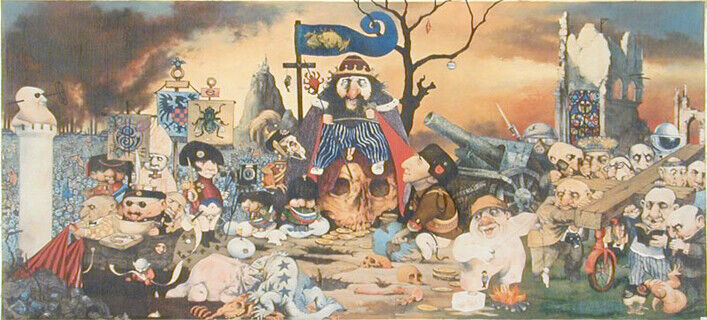
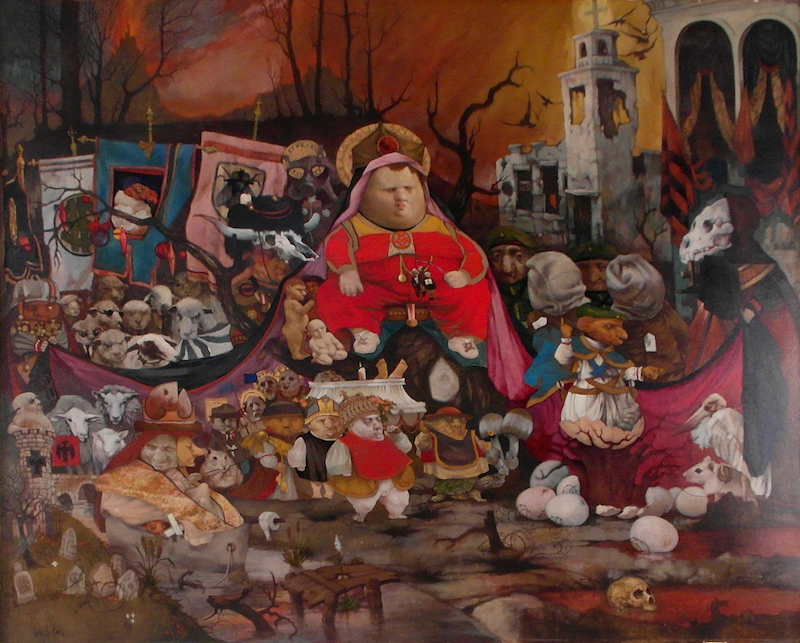
    I decided to go down the rabbit hole and sure enough, Bragg did in fact paint two Asylums: one oil on paper (16 x 34 inches), and another oil on board (30 x 40 inches)—the piece I grew up mesmerized by.

    These two distinct and compelling versions masterfully depict the artist’s satirical yet disturbing view of American society’s madness. Below is a brief exploration and comparison of these iconic paintings, shedding light on their profound symbolism and thematic evolution.

    Brief Introduction to Charles Bragg

    Charles Bragg (1931–2017) was an American artist renowned for his deeply satirical and often cynical depictions of humanity. Described as the modern-day Hieronymus Bosch, his work is a social commentary and critiques the follies of politics, religion, war, and societal norms. The year 1968 was a period of immense global turmoil—marked by the Vietnam War, political assassinations, and widespread civil unrest. Bragg’s two Asylum paintings from this year serve as powerful allegories for a world he saw as having descended into madness, with the lunatics running the institution. Though they share a title and a theme, these two works offer distinct, complementary visions of this societal asylum.

    1. The Asylum (1968, Oil on Paper, 16″ x 34″)

    Charles Bragg - The Asylum 1968, Oil on Paper, 16" x 34"
    Charles Bragg, The Asylum, 1968, oil on paper, 16 x 34 in. Collection of NSU Art Museum Fort Lauderdale, Gift of D. Robert Silber. Image source.

    Overview

    This horizontally oriented painting offers a chaotic, almost carnivalesque representation of societal breakdown. The palette is vibrant yet unsettling, dominated by surreal colors ranging from muted blues and reds to earthy tones and grayish hues. It possesses a satirical wit that underscores its commentary on madness, war, and institutional corruption.

    Central Imagery

    At the heart is a figure resembling a king or tyrant, absurdly enthroned atop an enormous skull, draped in striped pants, and wielding symbols of mock authority. His absurd attire and comically fierce expression heighten the ridicule of oppressive authority figures. The giant skull symbolizes death underpinning authority, hinting at the destructive nature of unchecked power.

    Key Symbolic Elements

    • Central Throne (Giant Skull): Represents authority built upon death and violence.
    • Tyrannical Figure (King): Satirical embodiment of oppressive, authoritarian madness. His striped pants and self-important posture heighten the mockery.
    • Mechanized madness (Smokestacks): Symbols of man-made destruction, pollution, and societal corruption.
    • Populace and War (Cannon): A massive cannon is aimed not at a foreign enemy, but at a huddled mass of pale, ghoulish figures—the common people, who are the ultimate victims.
    • Blind Obedience (Animal-Human Hybrids): Figures illustrating blind conformity and loss of individual identity.
    • Institutional corruption (Dilapidated Cathedral): Symbolizes the decay of faith and civilization.
    • Detritus (American self-deprecation): Skulls, bones, and grotesque creatures like a star wearing lizard battling an obese counterpart—a critique of Americans.

    Interpretation
    Though unsettling, the painting maintains a darkly comic undertone. It critiques institutional madness, war, hypocrisy, and authoritarian absurdity, using humor and grotesquerie to expose the folly behind power structures and societal collapse.

    Exhibition Catalogue

    • Taylor, Geoffrey. “The Asylum. 1968 oil, 16 x 34″.” The Absurd World of Charles Bragg. New York: H. N. Abrams, 1980, pp. 2-3.
    • Taylor, Geoffrey. “The Asylum. 1968 oil, 16 x 34″.” The Absurd World of Charles Bragg. Rev. ed. New York: H. N. Abrams, 1991, pp. 2-3.
    • Bisbort, Alan. “Asylum, 1968.” Charles Bragg: The Works! A Retrospective. Foreword by Richard B. Stolley. Pomegranate, 1999, pp. 60-61.
    • The Asylum.” NSU Art Museum Fort Lauderdale Collection. NSU Art Museum Fort Lauderdale, https://collection.nsuartmuseum.org/mwebcgi/mweb.exe?request=record;id=19144;type=101. Accessed 27 July 2025.

    2. The Asylum (1968, Oil on Board, 30″ x 40″)

    Charles Bragg The Asylum 1968 Oil on board 30 x 40"
    Charles Bragg, The Asylum, 1968, oil on board, 30 x 40 in. Private Collection

    Overview

    This large magnum opus is far darker, heavier, and psychologically intense. Its vertically oriented format enhances a claustrophobic, oppressive mood. Dominated by deep reds, browns, and shadowy blacks, it suggests a scene unfolding in the deepest corners of the human psyche or a symbolic Hell itself.

    Central Imagery

    A grotesque, infantile figure dressed in extravagant papal attire sits imposingly at the center of the composition, suggesting a perverse blending of childlike innocence and sinister authority. His blank yet unsettling expression evokes the chilling nature of corrupted innocence and blind tyranny. He reigns over a macabre earth littered with bones, skulls, and cracked eggs—symbols of decay, moral rot, and wasted potential.

    Key Symbolic Elements

    • Central Figure (Infantile Pope): Grotesquely obese, robed in red and pink, and surrounded by a golden halo—a parody of divine authority and the cult of personality.
    • Root Throne: The pope appears to be riding on a tree root, suggesting the figure is being supported by or pulled into hell.
    • Volcanic Crater: A rupture in the landscape, perhaps nature’s response to human madness—a fiery womb of destruction.
    • Masked Clergy and Executioners: Represent institutional complicity and moral decay.
    • Banners with Distorted Religious Symbols: Highlight institutional hypocrisy and corrupted spirituality.
    • Graveyard Imagery: Tombstones, crosses, and skulls form the literal and symbolic ground of the painting.
    • Cherubs and Death Figures: Mixes Christian and occult symbols into a fevered vision of apocalypse.

    Interpretation
    This painting abandons the lighter comedic elements seen in the other piece and fully immerses the viewer in a sinister vision. It suggests Bragg’s most intense reflections on madness: institutionalized, oppressive, and all-consuming. If the smaller painting mocks society, this larger masterwork condemns it, creating an intense feeling of unease, confrontation, and indictment.

    Exhibition Catalog

    • “Asylum 30 x 40” Charles Bragg. Exhibition brochure. New York: ACA Galleries, c. 1974-75, p. 5.
    • Taylor, Geoffrey. “The Asylum. 1968 oil, 30 x 40″.” The Absurd World of Charles Bragg. New York: H. N. Abrams, 1980, pp. 86-87.
    • Taylor, Geoffrey. “Madness in Progress (The Asylum).” The Absurd World of Charles Bragg. Rev. ed. New York: H. N. Abrams, 1980, pp. 30.
    • Taylor, Geoffrey. “The Asylum. 1968 oil, 30 x 40″.” The Absurd World of Charles Bragg. Rev. ed. New York: H. N. Abrams, 1991, pp. 86-87.

    Comparative Analysis:

    Attribute“The Asylum” (Oil on Paper)“The Asylum” (Oil on Board)
    Size16″ x 34″ (horizontal)30″ x 40″ (vertical)
    PaletteBright, surreal, satiricalDark, oppressive, apocalyptic
    Central FigureComically authoritarian, absurd, seated on skull throneInfantile pope-like figure, chilling, sinister
    SymbolismWar, absurdity, satirical chaosMoral corruption, death, spiritual collapse
    ToneDarkly humorous critiqueDeep psychological indictment
    Overall ImpactSocial satire, absurdityProfound, disturbing, unsettling

    Bragg’s evolution from mocking satire to apocalyptic vision emphasizes the profound shift from viewing madness as a human folly to recognizing it as an existential threat.

    Together, these two masterpieces from 1968 create a powerful and comprehensive vision of a world that has lost its reason—a societal Asylum depicted with Charles Bragg’s signature wit and brutal honesty. If this is what Bragg was painting in response to the world of 1968, one can only imagine—perhaps dread—what he might paint today.

    Facebooktwitterlinkedinrssinstagram
  • William Henry Drake: Brought The World To Life And Ended In A Suffocating Death

    Facebooktwitterredditpinterestlinkedintumblrmail

    William Henry Drake (1856-1926) was a renowned American artist who captured the majesty and power of animals and landscapes in his paintings. Though born in New York City, Drake considered Cincinnati his home, having moved there at a young age. His artistic passion emerged early, leading him to study at the McMicken School of Design. His fascination with animals, particularly lions, began to take shape there.

    Artistic Journey Begins

    Drake’s artistic journey took him back to New York in 1882. He spent countless hours sketching at the zoological gardens in Central Park and the Bronx, meticulously observing the creatures’ anatomy and habits. However, he quickly discovered the market for animal-themed works was limited. He continued to hone his skills with general illustration for several years before embarking on a transformative trip.

    In 1887 and 1889, he studied at the prestigious Julian Academy in Paris, further refining his technique. He also took this opportunity to travel through Europe, enriching his artistic perspective.

    A true adventurer, Drake undertook a 10,000-mile expedition to Alaska in 1893, gathering inspiration for his art amidst the rugged wilderness. This spirit of exploration continued with a sketching trip to the Catalina Islands to study seals.

    Jungle Book Commission

    A defining moment in Drake’s career came with the illustration of Rudyard Kipling’s “Jungle Book.” This project allowed him to fully embrace his love for depicting the animal kingdom. Following this success, Drake transitioned from illustration to focus on painting. His canvases, featuring creatures from wild habitats, garnered significant public appreciation and critical acclaim.

    Drake’s artistic achievements were recognized through numerous awards and exhibitions. He received honors at the Paris Exposition, the Salmagundi Club, and the American Watercolor Society. Paintings like “The First Born” and “The Royal Family” solidified his reputation as a master of animal portraiture.

    Beyond Lions

    He also proved to be a highly diversified artist, having painted landscapes during his travels. One such painting is a 1913 work of a Hawaii volcano. This painting is believed to have been executed during a round-the-world trip from New York to Madeira to the Catalina islands, including a stop in Honolulu. This global adventure demonstrated Drake’s artistic curiosity and willingness to explore subjects beyond the animal kingdom. One hundred and twenty-five of these watercolors were exhibited in April 1915 in New York under the title “Around The World.”

    Associations

    Drake was a member of prestigious art organizations, including the New York Art League, American Watercolor Society, New York Watercolor Society, Salmagundi Club, and the Artists’ Fund Society.

    A Tragic End

    We might speculate Drake had been suffering from some type of debilitating disease. Although a note was left for his niece at the time, we do not know what words it contained. On January 23rd, 1926, at the age of 70, William Henry Drake locked himself inside his studio’s closet. He took with him a container of illuminating gas, the highly toxic fuel used in lamps at the time, which tragically ended his life by asphyxiation.

    From Lions to Lava, William Henry Drake’s legacy as an artist who breathed life and majesty into creatures and landscapes endures through his paintings.

    Facebooktwitterlinkedinrssinstagram
  • The origins of Suridealism

    Facebooktwitterredditpinterestlinkedintumblrmail

    A Movement You’ve Likely Not Heard Of

    There’s a special thrill in uncovering the forgotten corners of art history, finding those fascinating movements that never quite made it into the mainstream narrative. Suridealism is one such discovery – a compelling, albeit lesser-known, artistic and literary current from the early 20th century that shares some DNA with its famous cousin, Surrealism, yet fiercely maintained its own distinct identity and contested origins.

    The term “Suridealism” was first coined by Emile Malespine (1892 – 1952) in 1925. He introduced the concept in the seventh issue of the magazine Manometre with his “Manifesto Du Suridealisme.” In this manifesto, Malespine articulated a core principle of Suridealism, stating, “Idea, ideal: Suridealism is both of these things at the same time; the idea is mixed with the word and becomes an image.” He also sought to bridge the gap between the conscious and unconscious mind: “conscious and unconscious: these two terms must be identified in a higher idealized term. Suridealism will therefore be, in its most general expression, a consciousness awakened by unconsciousness, and this consciousness, in turn, modifies the subconsciousness.” [i]

    Malespine’s manifesto included a lengthy list of artists he considered Suridealists, featuring a diverse group including Hans Arp, Marcel Arland, Victor Brauner, J. L. Borges, Robert Delaunay, Tristan Tzara, and many others who were also associated with various avant-garde movements of the time, including Surrealism, Dadaism, and Futurism.

    Adding another layer to the story, the term Suridealism was also adopted by the novelist Maryse Choisy in 1927 to describe a distinct literary movement. [ii] Choisy’s Suridealism had a clear feminist agenda, aiming to counter the male dominance prevalent in the contemporary Surrealist movement and to innovate within the genre of fiction writing.

    Choisy initially claimed to be the originator of the term, a claim strongly refuted by Malespine. In his July 1928 article “Proteste” published in Der Sturm, Malespine vigorously defended his priority in coining and defining Suridealism. [iii] His tone was notably stern, criticizing certain Parisian artists whom he felt acted with an air of superiority, even to the point of trying to claim a term that was already in use. Malespine recounts that Choisy invited him to join her movement, which he publicly declined, having already established his own.

    In describing her vision of Suridealism, Choisy emphasized the role of women and youth. She wrote, “Women are often criticized for being conservative, for being incapable of creating or even following the avant-garde movements. It is up to a few creative women painters and talented musicians to prove otherwise. A Suridealist group of under 30s has just been founded, which has gathered the most important names among the rising generation.”

    Choisy further articulated her movement’s philosophy: “Our century is the century of youth. But it is also the century of women. The purely masculine civilization is a failure. It is up to the woman to set the tone, which does not mean that we exclude the man from our songs or from our meetings. We are more generous, more inclusive. There are men in our group and even in our committee. But the crusade of Suridealism is led by women.” She concluded with a focus on emotion over pure intellect: “Pure intelligence has gone bankrupt. Help will come from the heart. Not from a heavy heart or a heart lush from the senses, but from a heart bursting from emptiness. A Suridealist heart. In the heart vs. intelligence match. Suridealism cheers for the heart.”

    Beyond Malespine and Choisy, the term appeared occasionally in other contexts. In the French publication Tambour (1929-1930), author Richard Thoma mentioned Suridealists alongside other major art schools like Surrealists, Cubists, and Futurists, suggesting it was recognized, at least in certain circles, as a distinct category of artistic expression. [iv]

    Interestingly, the term popped up in American media in the late 1930s. The New York Times first used it on April 25th, 1937, labelling artist Frank Marvin Blasingame a “suridealist.” [v] Blasingame appears to be the only American painter given this specific moniker, and it’s possible this usage was independent of or unaware of its earlier French origins. The term was used again the following year, on July 17th, 1938, in the Asbury Park Press, describing Blasingame’s “ultra-modern” work and referencing the earlier Times article. [vi] Donald Bear, then Director of the Denver Art Museum, commented on Blasingame’s paintings in the same article, noting their “great power of spirit” and viewing them not as ordinary pictures but as “provocative symbols that call up states of imaginative tension.”

    More recently, in 2018, Suridealism was revisited by Antonello Morsillo in his exhibition and accompanying book, Il Suridealismo nell’arte (Suridealism in Art). Celeste Network described Morsillo’s book as “a small treatise on philosophical aesthetics, is completely pervaded by the perception of considering art as an ethical urgency.” [vii]

    While never achieving the widespread recognition of Surrealism, the history of Suridealism, with its complex origins tied to both Malespine’s broad artistic vision and Choisy’s specific feminist literary aims, along with its sporadic appearances in art criticism, offers a fascinating glimpse into the dynamic and often overlapping avant-garde landscape of the early 20th century and beyond.


    References:

    [i] “Suridéaliste manifesto” Manometer no. 7, February 1925.

    [ii] “Manifeste Suridealiste” Les Nouvelles littéraires1 22nd October, 1927.

    [iii] “Proteste” Der Strum, July 1928 page 241. Available at: https://magazines.iaddb.org/issue/DSTURM/1928-07-01/edition/19-4/page/1

    [iv] “Alstair” Tambour No. 7. 1930. In: Salemson, Harold J. Tambour. United Kingdom, University of Wisconsin Press, 2002.

    [v] “FIVE NEW GROUP SHOWS” New York Times, 25th April, 1937 page 172.

    [vi] “‘Suridealist’ Settles Down” Asbury Park Press, 17th July, 1938 page 14.

    [vii] “Suridealism in art and Suridealist art as an ethical urgency” Celeste Network 14, November 2018. Available at: https://www.celesteprize.com/eng_artista_news/idu:62838/idn:42227/

    Facebooktwitterlinkedinrssinstagram